
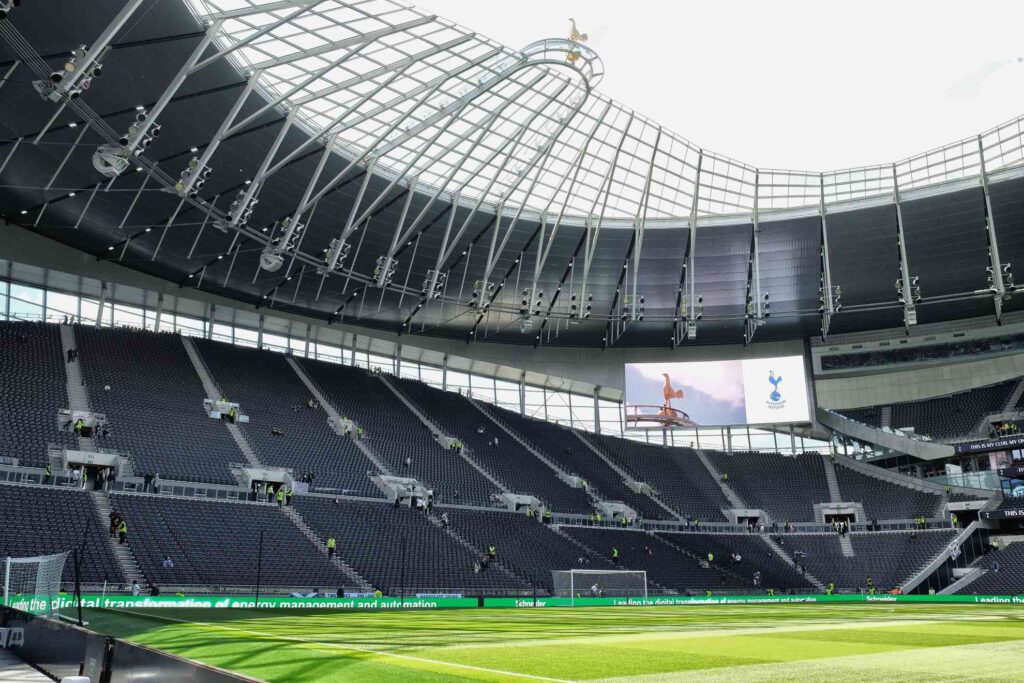
NFL stars called Tottenham’s surface “cement”, and after another ACL injury for Spurs, questions return over whether the retractable pitch plays a role in their injury crisis
Tottenham’s injury crisis deepened again on Tuesday night when winger Wilson Odobert suffered an ACL injury in the 1-2 defeat to Newcastle, after his foot appeared to stick in the turf while turning.
The 21-year-old has now been ruled out for the season. But rather than a disappointing one-off, the injury adds to what is becoming one of the most prolonged and unusual injury runs seen in the Premier League history.
Odobert’s injury adds to the recent long-term blows suffered by the club:
In 2026 alone, Rodrigo Bentancur underwent surgery in January on a right hamstring injury and is expected to be out for around three months. Mohammed Kudus also suffered a thigh injury in the same month and is also set to miss a quarter of the year.
Ben Davies picked up a season-ending ankle injury last month too, while Lucas Bergvall also suffered a similar injury and is not expected back for another few months. Richarlison, Kevin Danso, Pedro Porro and Destiny Udogie have also suffered injuries this year that rule them out for at least one month.
And that’s added to the long-term absences of James Maddison and Dejan Kulusevski who have yet to feature at all this season.
Ange-ball or Frank-ball: No difference
For much of last season, the explanation behind the injuries was simple: Ange Postecoglou’s high-tempo, end-to-end football. But the problem has not disappeared and, in some ways worsened, under the far more pragmatic approach of Thomas Frank.
The finger has been pointed at Tottenham’s medical team for their role in the injury crisis, to the point that Spurs went out and made a new hire in the department earlier this month, in the form of Liam Horgan, brought in as the club’s first-team rehabilitation physiotherapist.
All of this has led many Tottenham fans to repeatedly point to a different possibility: the Tottenham Hotspur Stadium itself.
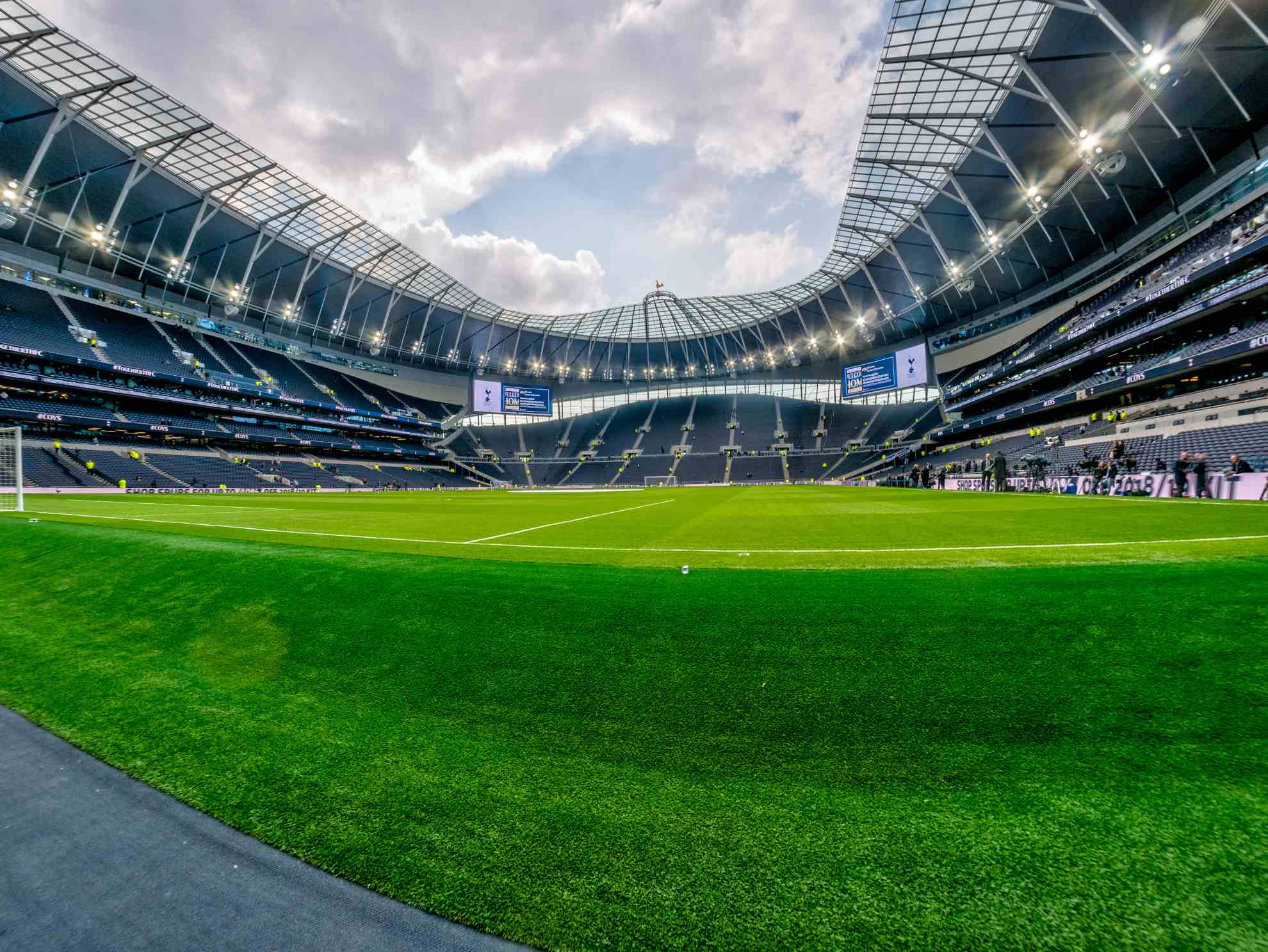

The unusual pitch beneath Spurs’ pitch
Tottenham do not play on an artificial surface but they also do not play on a conventional football pitch.
Unlike any other in the Premier League, the pitch was designed to accommodate NFL games as well as football matches, and to achieve that, it features a retractable system.
The natural grass football pitch slides on enormous rails into the stadium when not in use, revealing a synthetic NFL field underneath.
This structural engineering ensures that the stadium can host multiple events, but it also means that the grass pitch sits on a mechanical platform rather than the natural soil that most football pitches rely on.
How Tottenham’s pitch differs to others: Shallower soil, harder surface
This difference has a tangible impact on the way the pitch behaves. In a traditional stadium, a grass field rests on deep soil layers that absorb impact forces naturally. Tottenham’s pitch, however, must balance weight, stability, and mobility.
The root zone of the grass is shallower to allow for movement, and the grass anchors into a reinforced sand-based carpet rather than a deep layer of soil.
Beneath the grass is a rigid supporting slab, and the entire system is engineered to maintain consistent weight and moisture levels to allow it to slide safely.
Suggested Articles



The result is a pitch that is firmer and more energy-returning than a conventional football field, with greater traction and stability, but less natural “give” under a player’s feet.
It is this structural difference that helps explain why online theories about Spurs’ injury crisis persist, even though players never actually play on the NFL surface beneath the grass.
What NFL players have said about Tottenham Hotspur’s pitch
Many NFL players who have played at the Tottenham Hotspur Stadium in recent years have made some stark comments about the pitch, that take on a new dimension in the context of Spurs’ current injury crisis.
The fact that NFL matches at Tottenham are played on artificial grass led these comments to be seen as irrelevant to the football field, yet both surfaces have the same issue when it comes to the shallower soil, and firmer surface upon which each pitch rests on.
⚪️ Tottenham have parted ways with Thomas Frank but now face a tricky situation:
🤔 Hire a full-time manager now to boost survival hopes, or wait for their first choice in the summer.
These are the main candidates 👇https://t.co/8bLGr9ewQ7 #THFC #USMNT
— BBSportNews (@thebbsportnews) February 11, 2026
Several players were blunt in their criticism of the NFL surface. Taron Johnson of the Buffalo Bills said, “The turf was terrible here. They have to get rid of it. If we can do grass, we should do grass,” adding that his foot had “got stuck in the ground… I’m OK, thank God.
“Take that turf out, especially that one. I’d rather play on grass – I’m sure 90 to 100 percent of the players in the NFL would rather play on grass.
“There were injuries on the field today, some really really bad. I feel like the turf has something to do with it.”
An anonymous Bills player reportedly remarked, “We came all the way over to London to play on (bleeping) cement?”
Von Miller described the surface as “hard and tight and stiff… like it didn’t have any padding underneath – some of the worst turf that I’ve played on.”
The complaints were not about the grass itself, but about the interaction between feet and surface – specifically the hardness, traction, and energy return – issues that stem from the engineering of the platform rather than the quality of the grass.
While there is no scientific evidence linking the pitch to the team’s injuries, the way the pitch is built – a natural surface on top of a mechanical, reinforced platform – does change how force is transmitted through a player’s legs.
When a young player like Wilson Odobert goes down, clutching a knee after a planted turn, it is understandable why some fans and commentators draw connections between these injuries and the stadium itself.
The NFL player quotes do not prove causation, but they illustrate that the stadium is structurally different from any other in the Premier League, and that differences in underlying support can meaningfully affect traction and impact forces – factors that remain under discussion whenever Tottenham’s injury crisis deepens.