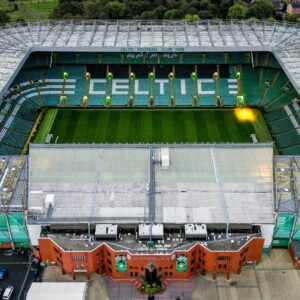

On Saturday, Celtic host Hearts in the final game of the season in an encounter that will determine the destination of the league trophy
On Saturday, one way or another, the most exciting Scottish Premiership season in living memory will come to its conclusion. After a dramatic season of twists and turns, surprises, controversies, upsets and comebacks, the league title will be decided on the final day when Celtic host Hearts at Celtic Park.
This is the first time this century that the top two teams in the league will face each other on the final day of the season with the title still to play for. Not since the 1991 has so much been riding on one single game as the campaign comes to its close.
It is not a stretch to say that Celtic vs Hearts on Saturday is the biggest league game in Scottish football this century. Whatever happens, it will go down in history as one of the most intense climaxes to a season ever.
Has this ever happened before?
There are few precedents for such an occasion as the one that will unfold in the east end of Glasgow on Saturday at 12:30 local time. In fact, it will be just the third time in history that the top two teams meet on the final day of the league calendar with the title at stake.
The last comparable situation – and an almost identical one, albeit with different teams involved – was in 1991 when Aberdeen went to Rangers needing at least a draw to win the league, while the home side needed a win. Rangers won the game and secured the title, their third in what would become nine in a row.
Prior to that, the only other occasion that didn’t result in post-season playoffs – as leagues used to be decided – came in 1965 when Hearts hosted Kilmarnock needing any result better than a 2-0 loss due to their superior goal difference. Unfortunately for the Jambos, the visitors did indeed win 2-0.
𝐏𝐑𝐄𝐒𝐒 𝐂𝐎𝐍𝐅𝐄𝐑𝐄𝐍𝐂𝐄: 𝐃𝐄𝐑𝐄𝐊 𝐌𝐂𝐈𝐍𝐍𝐄𝐒
Derek McInnes meets the media ahead of tomorrow’s season finale at Celtic Park 🗣
Get closer to Hearts with @FanHub 🙌 pic.twitter.com/nAkgUnJfTf
— Heart of Midlothian FC (@JamTarts) May 15, 2026
Losing sight of the excitement
At a time when Scottish football should be celebrating one of the most exciting and competitive seasons ever, though, some fans, pundits, clubs and managers are becoming embroiled in petty arguments.
It happened when the post-split fixtures were announced. Many fans would have preferred a different order of fixtures for their team and the fact Hearts were not given a home game to end the season was deemed controversial.
As was well documented at the time, however, that was an almost impossible situation to resolve. In the end, the favourites for the title – Celtic, who entered the split in 3rd – will have a home game to end the campaign, which was ultimately the point, to give the likely champions a chance to celebrate in front of their own fans.
The paranoic complaints didn’t end with the fixtures, however, and this week has been a case study in how narrative and recency bias still dominate football commentary and analysis.
The overblown VAR controversy
On Wednesday night, with Hearts winning against Falkirk, Celtic needed to beat Motherwell to give themselves a chance of winning the league on the final day without relying on goal difference. They did so, securing the victory with a late penalty, awarded for a handball after a VAR review.
The fallout from that incident has been of bewildering proportions and can only be explained by the moment it happened and the desires of so many to see Hearts emerge as champions this season. There have been thinly-veiled accusations of bias from both Hearts and Motherwell, piling the pressure on the Scottish Football Association and its referees ahead of Saturday.
The incident itself was not actually that contentious: the ball clearly struck the hand of the Motherwell defender when in a raised and unnatural position. Most referees see that as a penalty these days and John Beaton didn’t take too long to arrive at that obvious conclusion.
🟢 Here’s the incident that resulted in Celtic’s winning penalty at Fir Park, following a VAR check!
Motherwell vs Celtic & Hearts vs Falkirk reaction | Sky Sports Football now 📺 pic.twitter.com/kwFO6mOH7t
— Sky Sports Scotland (@ScotlandSky) May 13, 2026
The league is won over the whole season
Even if there are question marks over the legitimacy of that decision, however, the over-the-top reactions from many sections of the football community that have proceeded it betray a fundamental misunderstanding of how a league season works.
The league title is decided over the entire season – in this case, over 38 games – and not in the final two or three games. Refereeing decisions are debated every single week and there will be countless calls over the course of a season that fans consider have gone both for and against their team.
Without wanting to wade into the murky waters of such tit-for-tat nonsense, Celtic were denied a much clearer penalty in the first half against Motherwell. So the late penalty wasn’t even the most contentious call of the night, never mind the season.
Those with a memory of longer than a week will be able to reel off many decisions they disagree with, but refereeing decisions in January, for example, don’t carry the same narrative as those in June, evidently.
The last time that Celtic and Hearts met in the league, Celtic defender Auston Trusty was shown a very dubious red card with his side leading 2-1. With 10 men, the Hoops succumbed to a 2-2 draw.
The winners will deserve it, whoever they are
Indeed, when the margins are as fine as they have been this season, it is only natural to look to season-defining moments where the title was “won” or “lost”. That is all entirely subjective, of course, as every game counts the same.
If Hearts hadn’t dropped points against all of the bottom three teams in the league since February, for example, they would already be champions. Likewise, if Celtic hadn’t hired Wilfried Nancy, perhaps they would be ahead, and we could go on all day.
Ultimately, the team that wins the league is always the one that has deserved it the most over the entire season, no matter when they won their points or how many weeks they sat at the top of the table.
Saturday will be no different; whoever is celebrating will have earned the right to do so and we shouldn’t let rivalries or disappointments get in the way of recognising what a historic and exhilarating season this has been.