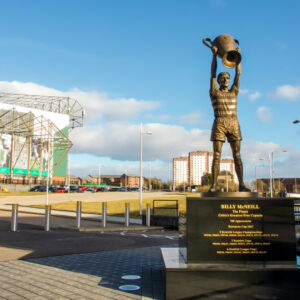

Celtic made it five SPFL Premiership title wins in a row at the weekend with a record 56th league trophy
For most people across the football world this week, Celtic are the villains who denied the fairytale finish for the underdogs. The Glasgow hegemony on the Scottish Premiership title came so close to being broken by a Tony Bloom-backed Hearts side that have caught the attention of fans around the world.
It wasn’t to be though – not this year anyway – and Celtic ended the season as champions again. Forget Glasgow dominance, Celtic are the single dominant force in contemporary Scottish football, now on a run of five consecutive league titles and victorious in 14 of the last 15 seasons.
To those on the outside, that can appear a little tedious, hence the hopes and expectations placed in Hearts’ challenge this season. A refreshingly competitive Scottish title race has been enthralling and captivated fans beyond the usual audience, and so it is only natural that there is a widespread and bitter frustration that it didn’t end the way so many were hoping.
Instead, it is Celtic fans who are celebrating once again and some pundits have even labelled this “just another title” or questioned if fans don’t get bored of this sort of thing. Such comments, however, not only seek to undermine the achievement of Martin O’Neill’s side, but also ignore the story and many subplots of Celtic’s season, not to mention the very nature of competitive sport and football fandom.
New ways of making history
To anyone who has been paying attention, this season has been anything but boring, even if the outcome looks somewhat familiar. Celtic may be the winners once again, but only after a rarely-seen three-way title race in which they often sat third, including going into the split, and at one point looked dead and buried, trailing the Jambos by nine points.
This was also the first time ever that Celtic have beaten their direct rivals on the final day of the season to win the league. It has only been done twice before in Scotland and neither prior occasion involved the Hoops, so it is no wonder that some players claim this title, a record 56th, feels better than any other.
It was a fittingly epic and dramatic finale on Saturday as Celtic scored two late goals to beat Hearts and overtake them in the table with the clock ticking on the league season. The nature of the split in the Scottish Premiership also ensured a highly competitive run-in that saw Celtic rise from third to first in the space of five matches over three weeks, beating both of their title rivals in the final seven days of the campaign.
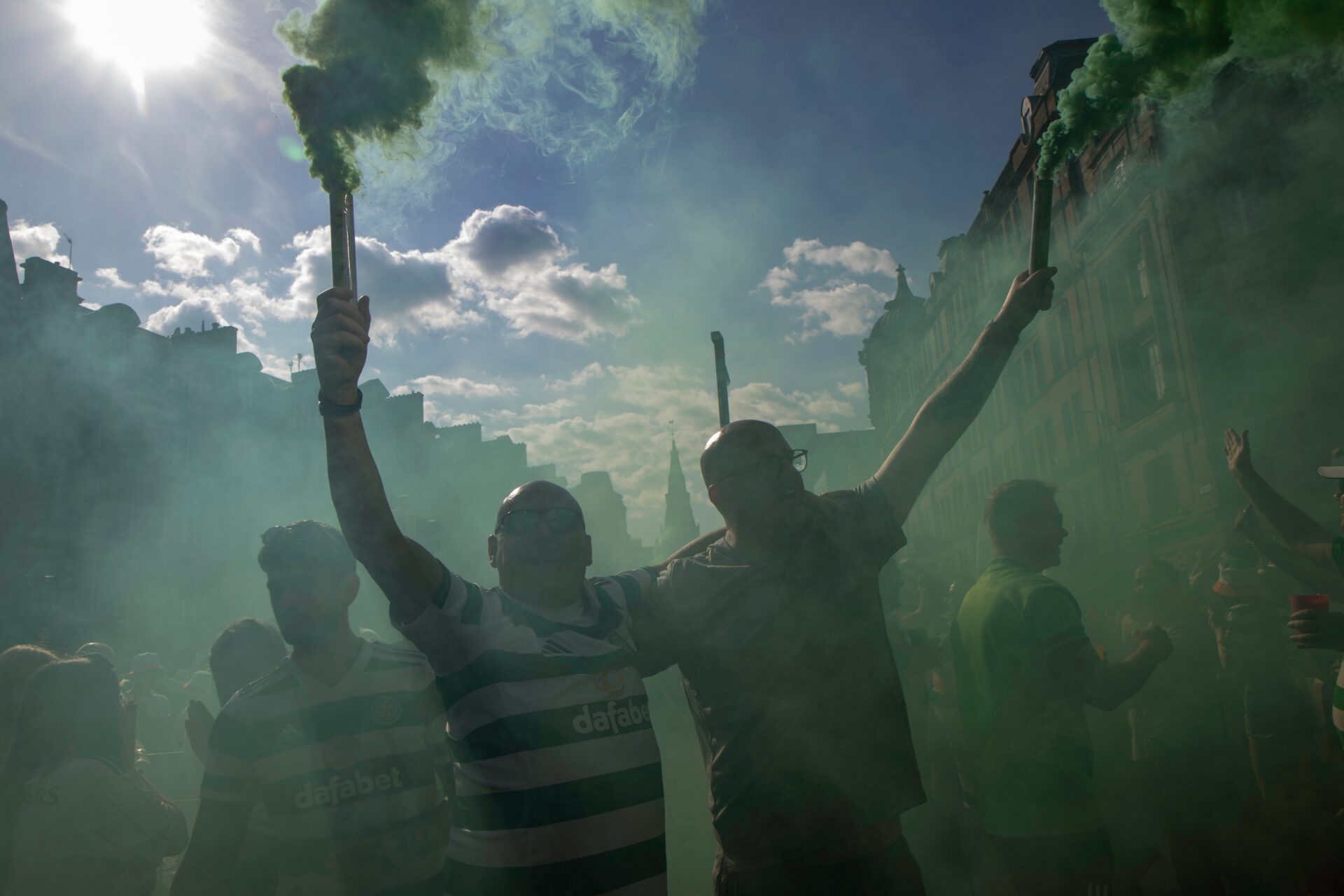
This year the split worked almost like a US-style post season, with just three points separating the top three ahead of a stretch of games in which they would all have to play each other and the other sides in the top six. In crunch time, Celtic delivered, winning all five matches to sneak ahead on the final day.
That is no mean feat and, indeed, Celtic remain the only top-six side to have ever won all five post-split games. This was the sixth occasion they had done so and nothing less would have delivered the title this time.
Triumph in the face of adversity
There was nothing inevitable about Celtic’s success, either, after an excruciating season that saw three managerial changes, two abysmal transfer windows and a club at war with its own fans. Star player Jota hasn’t kicked a ball all season, while other key members of the team such as Cameron Carter-Vickers, Alistair Johnston and Arne Engels have missed significant periods with serious injuries.
As for the turmoil off the pitch, fan protests remain ongoing against the board’s long-term handling of the club. Meanwhile, the main ultras group, the Green Brigade, have finally been allowed back into the stadium after five long months, but frictions remain between supporters and the club hierarchy.
Many of the club’s ills have been self-inflicted and Celtic looked on course to implode after the board’s relationship with Brendan Rodgers broke down spectacularly and the Irishman resigned in October, with the club publicly criticising him in lengthy statements that threatened to turn the whole affair into a soap opera. Into this chaotic mess stepped Martin O’Neill and the septuagenarian grabbed a misfiring team by the scruff of the neck and dragged them to seven wins in eight games as interim manager.
Then came the ill-fated reign of Wilfried Nancy, who took over the team days before embarking on a run of huge fixtures. After losing at home to Hearts in his opening game, Nancy lost the League Cup final to St Mirren a week later and was eventually sacked barely a month after his arrival with a record of two wins and six defeats in eight games.
O’Neill and his coaching team, including former players Shaun Maloney and Mark Fotheringham, returned to steady the ship, this time until the end of the season. It wasn’t always pretty or all plain sailing – far from it – but results improved and a strong mentality saw the Bhoys keep the faith and end the season on a high, grinding out wins on vibes, belief and sheer willpower.
There’s a fairytale about Celtic too
In the end, despite the story of the season being underdogs Hearts, Celtic’s comeback tale, led by a 74-year-old club legend, isn’t short on excitement or romance either. Full of late winners, setbacks and drama, this has been a season like no other and one that will go down in Celtic folklore as a truly special one.
For fans of a certain generation, the sight of O’Neill prowling the touchline in a Celtic tracksuit is powerfully nostalgic. The man is a club icon, synonymous with modern-day success and an era which he ushered in 26 years ago: Celtic in the 21st century cannot be understood without O’Neill.

Success is never taken for granted
Since O’Neill’s first arrival as Celtic manager in June 2000, the Bhoys in green have won 20 of the 26 available league titles. To put that in context, in the preceding 26 seasons, Celtic had won just 7 league titles, so those who know their history know that success is to be savoured and never taken for granted.
O’Neill in his first spell lifted Celtic to another level and restored a pride and winning mentality that have endured, like his legacy will, a legacy that has only been enhanced after his heroics this season. Celtic owe him an immense debt of gratitude and the chance to celebrate with him again will bring back all kinds of memories for those old enough to remember the first time around.
Ultimately, that is what football is about: the memories, the shared experiences, the hopes and expectations. Seeing O’Neill managing in club football again isn’t just about remembering his previous successes, it reminds all of us of where we were 21 to 26 years ago and prompts reflections on the changes we’ve gone through, the people we’ve met, the people who are no longer with us.
A lot has changed in 26 years, but seeing O’Neill smiling on the pitch at Celtic Park in 2026 is a reminder that football remains a constant throughout the many phases of our lives. There’s something magical about that and about the way he has twice this season galvanised a squad bereft of confidence.
A fitting farewell
In May 2005, O’Neill resigned from his role as Celtic manager in order to care for his wife, Geraldine, who was undergoing treatment for cancer. His side had missed out on the league title on the final day of the season after losing to Motherwell and seeing Rangers overtake them in the closing moments of the campaign.
Although he went on to lift the Scottish Cup days later, it was not the send-off the Irishman deserved. There is something heartwarming, and perhaps a touch of poetic justice, about the fact that 21 years later, the irresistibly likeable manager will be able to go out on a high after seeing things go his way on the final day this time.
On a personal level, surely few can begrudge O’Neill his moment. It could be the perfect retirement present, if he does indeed ride off into the sunset when his work is done after Saturday’s Scottish Cup final against Dunfermline.
It might not be the seismic event that Hearts winning their first league title since 1960 would have been, but Celtic’s triumph is still a story that will be told for years to come and full of its own kind of magic. And don’t tell fans it’s just another title – it never is, anyway.